Showing posts with label philosophy. Show all posts

Thursday, July 13, 2023

Two Philosophies

I've been theorycrafting a couple decks recently:

First, one based on the recent uptick of Red's wheel effects. 

2 Elixir of Immortality

2 Sheoldred, the Apocalypse
3 Magus of the Wheel
4 Shocker
3 Tourach, Dread Cantor
1 Glint-Horn Buccaneer

4 Waste Not

4 Dream Salvage
4 Infernal Grasp
1 Sudden Edict

11 Mountain
11 Swamp

2 Liliana of the Veil

4 Reforge the Soul
4 Burning Inquiry
This is clearly unfinished: I've got the most basic manabase for now, because I'm not sure how/if it will be interesting. There were also four Sheoldred, the Apocalypse in the initial build, but that card is $55+ and I can play Liliana of the Veil for $13. But after seeing someone play a Wheel deck on Youtube, I thought: but what if it had Tourach, Dread Cantor?

And here we are.

The second started as a G/W 'spells' build and changed to B/W because of my love of Agent of the Fates. 
4 Phalanx Leader
4 Mavinda, Students' Advocate
4 Leonin Lightscribe
4 Agent of the Fates
3 Tormented Hero
3 Sedgemoor Witch

4 Loran's Escape
3 Blessed Alliance
4 Guided Strike
2 Reverent Mantra

11 Plains
11 Swamp

3 Read the Bones
I really like Mavinda and definitely want to do something with this card. The switch from Green to Black came simply because of Agent of the Fates providing me more to do than anything Green had, which could effectively be described as "I'm big now". 

Big doesn't let you win games though; big and (something else) does, where the something else is trample or haste or 'fuck yo' stuff'. Having a vanilla 9/9 doesn't cut it. However, it is likely true that Green offers me more in the spells category. 

It was while playtesting both these decks, and Matt's reaction to them (he liked the first one more) I realized that there's two design philosophies at play here: one that proactively does stuff to your opponent, as with Red's discard continually disrupting their plan, and one that proactively does stuff just to you as with the B/W deck's plan. There really isn't an axis of interaction with the opponent, which puts it in the realm of a combo deck.

But combo decks need to vomit all their cards out by turn 3 and just win, otherwise the opponent gets to do things, and combo decks cannot allow that!

The other thing is that I have a deck that's doing something like what the B/W is doing, so maybe let's work on the R/B one...

But I'm out of town this weekend, so no new post until Thursday, July 20th!

Friday, February 15, 2019

Play for Loss

One nice thing about the internet is that you can be exposed to a lot of ideas that don't always correspond with your own. In this case, though, it's coming at me a little differently.

Most high profile articles on Magic are written by pros or people aspiring to be pros. That's understandable: They've put in the resources to understand the game at a higher level than most people. As a result, their view on Magic is often one where winning is the only thing that matters.

But I like to think that this article is the result, at least in part, of exposure to people who aren't playing to win but having a good time anyway.

Which is what it's all about, really.

Thursday, March 2, 2017

Learning Via Losses

This is a long one and it tends to focus more on the Commander format for its examples but I think it's worth the read.

I'm happy to say that doing the post-game debrief is pretty common amongst people I play with, as we're always trying to make the game better for each other. Suggestions for alternate cards and questions about different lines of play come up all the time.

I think that it's pretty cool that we're trying to help each other out.

In contrast, here's an article on dealing with wins.

I find it interesting, in that both things want to focus on process. Forget outcomes, look at how you are doing what you do.

Which is an interesting notion to ponder the next time I find myself winning anything. I am wondering if I focus more on process if I will be able to stay calmer and perform better.

Tuesday, March 31, 2015

Is It About The Game

I pinged stonethorn last week to see if he wanted to play cards and he responded in the affirmative, so off we were to the pub, right? It was early so I was hoping I'd have a chance to teach him how to play Star Realms, as well as get in a few matchups with Tinkertoy, now that I'd developed the new model with Trinket Mage.

We got our ales and settled into the 'how are things?' chat. The conversation went long before attention got directed towards playing a game. About one-third into teaching him  how Star Realms worked I realized; he's not into it. Not because the game is bad, but because he'd had a long day.

Sometimes that happens: your brain just doesn't want to cooperate and when it is fortified by some truly excellent imperial stout from the Commons, it's better to just call the whole thing off. We ended up going to the Lovecraft, checking out pretty women from afar and eventually I played the designated driver to get him home safely.

Because I don't just play Magic to play Magic.

Thursday, January 8, 2015

Seriously, Gorram Blue!

Fate Reforged Spoilers have begun!

And goddamnit, they have given Blue a card it had absolutely zero need of: easy, instant speed, creature removal: Reality Shift.

You know, just when the game starts to get more balanced from a color-pie perspective, a block like Khans shows up and throws it all away. Treasure Cruise and Dig Through Time are already so format warping that people are calling for them to be banned in Legacy and Modern. Did Blue really need a card that could take care of almost any creature and replace it with something that is a 2/2 nothing? Because the odds are heavily in the Reality Shift player's favor that they will be manifesting a land or spell, not a creature.

So your best creature is now a bear.

That's just ducky.

But wait, 'Blue has had Polymorph for years', you say, 'how is this any different!? Why isn't Curse of the Swine creating an outcry!'

Two ways; first, Curse of the Swine is a Sorcery and second, costs 3, minimum, to work. That is a lot of mana for Blue and arrives at an inconvenient time. Other Polymorph-like effects don't exile, which means that Green (Blue's primary adversary) White and Black can get potential mileage out of those destroyed creatures because they have graveyard interactions.

But instant speed permanent creature removal has never been a strong part of Blue's domain and Reality Shift's printing at uncommon means that they want to make the best color in Magic the best color in Magic.

That kinda sucks.

Thursday, March 6, 2014

Two Mana

There seems to be a magic mana number in the game and I'm starting to think that number is 2. Anything that is one or zero mana is clearly a) underpowered (Healing Salve) or b) crazy (Force of Will) or c) crazy in the right deck but otherwise meh (Invigorate in infect decks). Very, very few cards hit the 1 mana 'playable and solid' line-Duress comes to mind with Lightning Bolt being at the high end of the power spectrum.

At two mana though, this is where the rubber starts to meet the road. Nearly every deck gets to two mana in nearly every game so what you can do with it matters and Magic is packed with cards that are truly useful at that converted mana cost. You can even see it in Standard, where at the last Born of the Gods event, the highest concentration of cards was at the 2 CMC slot. One of the most powerful spells, Counterspell, is at two mana and it choked so much design space out of the game WotC had to push hard counters back to three mana-although it took them years to do so.

I think it's also why so many limited environments are designed with cards to hit 2.x on the curve. A deck that can reliably do something on turn two, every time, means fast, demanding games that are more luck oriented but if you push the curve to three, deckbuilding skill and card evaluation start to come into play and as you see more of your deck, variance is decreased.

In constructed this is a different animal, of course because you can develop decks that can turn things around on turns 3 or 4 to give you a chance to win. Nevertheless, after my experience against the Painter's Servant deck where I would have had an opening to win, if I had kept Pyroclasm in, I've been thinking about it more.

This motif repeats: The Prismatic Prism in My Curse, Black Sun's Zenith in Slave to the Grind and Wall of Omens in Perpetual Motion.

All these decks had problems with solutions coming at the 2 CMC slot. I discovered these solutions after I was finished talking about them on the blog; that frequently happens. Decks I write about stay in playing rotation for a little while to work out any kinks, longer if I have an identifiable problem or question that I can work on. If it's just a 'blarh, this isn't working and I don't get it' then I let it rest. Eventually, a solution comes to mind or a new card is printed to solve problems. 

None of these solutions are what I'd call gamebreakers; they don't have the power of something like Snapcaster Mage or Tarmogoyf but they end up being the glue that helps hold the decks together. This is a good thing to keep in mind when looking at where to go with a deck that has hit a stumbling block.

Tuesday, November 26, 2013

Perspectives (Again)

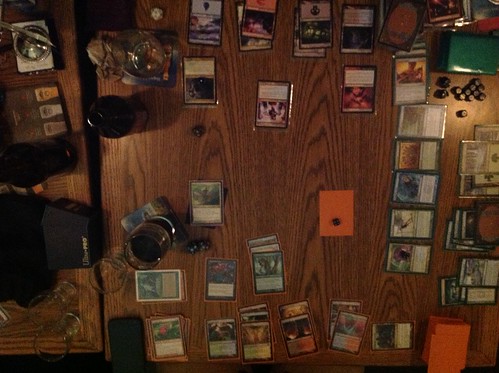
What we have here is a Commander game with me playing Jeleva at the top, Noah with Horde of Notions at the bottom, and stonethorn with Experiment Kraj on the right.

I made two mistakes in this game, the second one being irrelevant to my story and probably stemming from the first. However, I'd like to start with the upside.

Jeleva: still fun. I managed to get her out twice and although I didn't really hit any spells worth playing either time what I was able to do was remove cards from the game that might have been troublesome otherwise. There's always the psychological battle in Magic and seeing your stuff disappear tends to be a downer. I actually was starting to wish for ways to kill Jeleva at will, so I could have more opportunities to pilfer through my opponent's spells.

However, I made a very big mistake on turn seven. Noah was getting a nice combo set up using Sword of Light and Shadow, Eternal Witness and Phyrexian Altar to reuse anything he felt necessary. One notation from that game is that I have a lack of artifact removal with Jeleva and artifacts have been problematic in nearly every Commander game I have ever played. stonethorn, however, has green which means he's got that kind of removal. All I have to do is hope he'll draw into it: I can even copy that spell with Wild Ricochet.

I have a Spiteful Visions on the table (which I played to help kick the game into gear) and draw into Price of Knowledge. My thought it simply: this is a powerful card and I should play it. It's not like I'm taking over Noah's position as the actual threat here.

stonethorn promptly Krosan Grip'd my enchantment before the end of my turn and I no longer had mana available to play Wild Ricochet or anything else.

I couldn't understand why: it seemed like a play against me personally and that doesn't jibe with how Multiplayer should work-or how I thought stonethorn plays. I have a very important rule in Multiplayer games: play the board, not the person.

I have this rule because it's very easy to get wrapped up in vengeance. Too easy, frankly: the sting of a loss last game-or last week, or last month-is the kind of thing that humans get invested in payback.

And payback is a bitch. But that bitch goes both ways and I have seen players willfully ignore opportunities to win, screwing themselves over, in order to feed some kind of payback monster. I've done it myself, which, of course, is why I created the rule. Don't make it personal, play the best game you can and play that board.

The board said that Noah's position was a problem because he had an actual engine going on. I had some synergies but nothing that could really establish myself. So what happened?

I forgot to put myself in someone else's shoes. Just because you play the board not the person doesn't mean you should forget that people are in the game! From stonethorn's perspective, he was looking at taking 9 damage next turn and perhaps the turn after that, with no way to establish a foothold in the game and live long enough to knock Noah off his trajectory. Why should he allow that to happen?

Essentially, I forced stonethorn into a lose-lose situation, which compounded my poor board position and reinforced Noah's and I did this because I thought of doing cool things myself, rather than considering the position of other players. In a way, I played myself, not the board.

And that's all for this week. Thanksgiving means a break from writing. See you in a week!

Thursday, November 21, 2013

Moneydecks

How to do more with less?

The My Money philosophy has served me well: namely, it's prevented me from spending so much cash on Magic cards that I neglect to do things like purchase food or new underwear. You know how it is.

However: it cannot be denied that a key component to doing well at Magic is about money. The person who can purchase four Wurmcoil Engine, Deathrite Shaman and/or Jace, Architect of Thought has a much better chance of winning the match than someone who has only been able to acquire one or two of those through trade or luck. Hell, even someone who has the money to play draft and sealed often (something that can cost anywhere from $15-30 a pop) is going to have an understandable advantage over other players.

So I've spent a great deal of time trying to get decks to work with the expensive cards I happen to own (usually through random pack openings) or have purchased while they were cheap, because I like to gather up cheap rares and bend them into weird decks.

In the film Moneyball, a fiscally strapped baseball team uses mathematical metrics to get players who in aggregate, will hit the statistics that a team that makes the playoffs or wins the World Series would have. Similarly, I am trying to use cards that are undervalued or overlooked in order to create a deck with synergies that will produce wins. My hope is that with a deep cardpool (from a chronological perspective) and a willingness to experiment, I can pick up things that will pay off later, both in skills and cards. Lately, it hasn't quite been working out.

I don't mind losing but I seem to be doing it an awful lot, which suggests that I am not applying the lessons of my losses very well. I've also been ignoring some of my best (and expensive) cards in order to look at everything else in the name of innovating.

There isn't much point in letting a perfectly good Vraska sit in the binder though, when I have a deck that could use the power. I can still spend my money wisely and use overlooked cards while investing in some of the more expensive ones to help make my weird ideas work. I've been thinking about ways to make this happen, including changing some of my buying habits. Hopefully this will give me opportunities to pick up a few of the more expensive cards, while still absorbing copies of underused or overlooked cards and making them work for me.

Tuesday, October 29, 2013

Black Sunshine

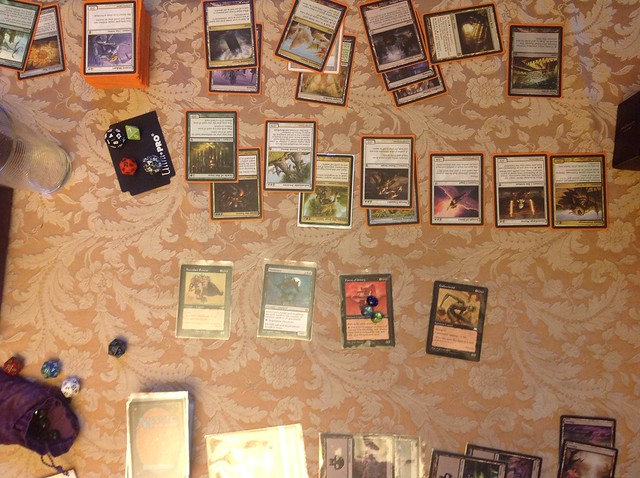
In this photo, I'm facing a Doran Commander deck piloted by Noah. He's clearly got the upper hand on me and that isn't going to change.

The game before, which I was so involved in I forgot to get a photo of, had me losing because I couldn't do anything about Primeval Bounty. I certainly tried, casting Geth after getting the ultimate on Liliana.

You can take a whole lot of goodies with that amount of mana, and I did. Going from 14 life to 66 life after stealing a Rhox Faithmender was pretty good times. 

But Geth died and I couldn't get him back to take Noah's Qasali Pridemage, so eventually I was just overrun by beast tokens.

However, this matchup taught me a few important things:

While my love for playing weird and underused cards is part of my Commander philosophy, I need to know when too many of those ideas have piled up in a deck, causing it to break down. In this case, it was the presence of Bad Moon and Gallowbraid and the ideas the represent.

Gallowbraid is a challenging card to play. Solid back in the days of Weatherlight, he was even part of a winning deck called the Brothers Grimm...which quickly faded from view. With the improved creature base of modern Magic, Gallowbraid just doesn't have a home. So naturally I need to play him. The upside though is that his drawback isn't so bad in a format where I start at 40 life, and trample is good almost anytime.

The problem with Bad Moon is a bigger one: it is actually a good card in the right deck and what better than a Mono-B one, right? However, most of the commanders people play with are multicolor ones and people especially love three-color generals. The popularity of the Commander decks Wizards makes helps promote three color decks too and impact of those decks means there is a very narrow group of commanders who don't have black in them. This means that I'm much more likely to give my opponents an advantage off of Bad Moon than I might be in other formats.

So something has to give: I can keep in the neat flavor but bad cards of things like Gallowbraid and Morinfen or I can keep in Bad Moon and Nocturnal Raid and try to shore up my weaknesses there. At this point, I'm going to keep the Brothers Grimm in and take out the cards that enable other people's decks, because the latter challenge is far beyond what I am willing to dedicate resources to.This means:

-Bad Moon, Nocturnal Raid and Cabal Ritual
+ Rune-Scarred Demon, Abhorrent Overlord and Baleful Eidolon. Which is going to come out for some graveyard recursion (getting Geth back would have saved me the game) or mass removal (ditto Infest or Nivenyarrl's Disk.)

Finally, this seems neat. It's a little too late for me to get involved but perhaps someone else can--and for next year, ,maybe I can work something out.

Thursday, October 10, 2013

Commander: Garza Zol, Plague Queen

I generally don't name my Commander decks, because they already have unique titles: the Commander leads the deck, thus bestows the name. But in this case, I have a little subtitle for this one,  Everybody I Know Has Fangs.

Commander:
Garza Zol, Plague Queen
 Artifacts
Blade of the Bloodchief
 Obelisk of Grixis
 Enchantments
False Demise
 Control Magic
Sorceries
Blood Tithe
Blood Tribute
Dream Cache
Earthquake
Rush of Knowledge
Slave of Bolas
Sinkhole
Feast of Blood
Exsanguinate
Consume Spirit
Soul Burn
Sunder from Within
Demolish
Lands
Crypt of Agadeem
 Dreadship Reef
 Urborg Volcano
 Crosis's Catacombs
 Lake of the Dead
 Barren Moor
 Izzet Boilerworks
 Dimir Aqueduct
 Rakdos Carnarium
9 Mountain
9 Island
11 Swamp
Instants
Brainstorm
Dark Ritual
Lim-Dûl's Vault
Swerve
Murmurs from Beyond
Repulse
Yamabushi's Flame
Glacial Ray
Reverberate
Sulfurous Blast
Think Twice
Urge to Feed
Vampiric Fury
Vampiric Tutor
Creatures
Lord of Lineage/Bloodline Keeper
 Blood Tyrant
 Vampiric Dragon
 Vampire Nighthawk
 Vampire Lacerator
 Izzet Chronarch
 Skeletal Vampire
 Sengir Nosferatu
 Sengir Vampire
 Baron Sengir
 Irini Sengir
 Child of Night
 Blood Seeker
 Rakish Heir
 Falkenrath Marauders
Creatures
Krovikan Vampire
 Kalitas, Bloodchief of Ghet
 Malakir Bloodwitch
 Guul Draz Vampire
 Gatekeeper of Malakir
 Butcher of Malakir
 Pulse Tracker
 Drana, Kalastria Bloodchief
 Mephidross Vampire
 Mirri the Cursed
 Guul Draz Assassin
 Captivating Vampire
 Bloodlord of Vaasgoth
 Triskelion
 Olivia Voldaren

I suppose that the first thing I ought to do is repeat my general Commander philosophy. This format is where I get to shove in all the weird, unused cards or singletons that I wouldn't get to play otherwise. In Commander, I try a little harder to consider theme and the glory of cool things, than I do the success of a plan in relationship to victory.

I realize that making a vampire tribal deck may not seem like something out of the ordinary but I dislike making decks that I know work. Vampires have been pushed steadily since Zendikar block and while I don't know that a winning vampire deck has been mapped out, making a traditional 60 card deck is just too easy. Unless I can put a slant on it that is unique (read: probably bad) then I find it difficult to be interested.

I frontload all this because I have had people tell me, in a slightly pitying tone, "Vampire Lacerator really doesn't work in Commander."

Trust me: I know how this format works. It works any way you want it to and I want to make a vampire tribal deck. It's OK if some of the cards are bad; that's partly why I'm writing, to properly look at these decks and swap bad cards for better ones.

But in Commander I'm more willing to accept my choices because they are cool. Telling me that something doesn't work when it's clearly part of the theme is ignoring what my goals are and is unhelpful advice. That doesn't mean I'm going to keep the Lacerator in forever but it's good for the time being.

Let's roll it out!

Tuesday, April 17, 2012

Anecdote

"I feel bad when I play that deck," he said to me after what I thought was a pretty solid game of Commander. His was a Saffi deck, abusing it with cards like Deathrender to give him an ever-present army. The usual suspects made the list: Stoneforge Mystic, Elesh Norn, Privileged Position, Argentum Armor, Sword of Feast and Famine, Linvala, etc. It took him awhile but he won that game through a couple solid board wipes. I felt OK about things myself, probably missing one play but otherwise doing pretty well, timing my plays mostly correctly, making the best of my resources. Everyone was nice so that's a pretty solid game, to me.

He seemed to want to talk about my deck but didn't know where to start. "You've got some powerful cards there but..." he trailed off, unsure of what to say next because, despite being told three times that it was a junky legend deck (Child of Alara with every legend I have that isn't doing anything right now which is a lot) he didn't seem to believe me. Or his own experience.

I shrugged, told him my deck was there to play stuff that didn't get seen otherwise. It's not that I wouldn't've liked advice but what is he going to tell me that meshes with my philosophy? I don't really care about winning in Commander, I care more about not losing with weird cards that nobody plays.

In the back of my mind, though, I couldn't help thinking: If playing a deck makes you feel bad, why are you playing it?

And: What is it about my attempt to have fun that puzzles you so?

Tuesday, April 3, 2012

We were so wrong to believe at all

I got a chance to run Oak God against Fuz and I don't remember all the matchups, I do remember that he was playing zombies, in one match and in game one, I got 7 druids including a Gilt-Leaf! So I stole all his lands, tapping out.

He promptly swung at me for 15 with two zombies and a Soulless One that was the size of Jupiter. So...yeah. Maybe jumped the gun there, you know?

In game two, I got out two Adaptive Automatons and a Gilt-Leaf Archdruid, only to have them meet their demise at the hands of Nameless Inversion. Fuz's analysis: you need a way to keep your stuff on the board. Something like Steely Resolve naming druids would work.

Which leads me to an interesting point: my deck isn't interactive and his was. His suggestion to improve my deck was to force his deck to play my game, since my combo isn't faster than his deck, thus actually increasing the interactivity I have with the game. That is: stuff that I have or play that does something to the resources my opponent has or plays.

I saw this on Monday night too: Why isn't my midrange deck working, thedrowningman asked. And it was because all he had was cards to set up his board and nothing to make sure that he could get to the midgame in tact. I pulled four cards and said: These need to be Doom Blades or discard or something that slows down the opponent.

After some pondering, this is the basic outline I came up with:

Aggro strategy: minimal interactivity.
Midrange strategy: maximum interactivity.
Combo strategy: zero interactivity.

Things get muddled, of course (control-combo, aggro-midrange, blahblahblah) but those are the guideposts. If your combo deck is properly built, it is there to win faster than any other deck can win and to do that, it has to dedicate every resource it can to doing that: planning for what the opponent does is irrelevant and dilutes your strategy. Of course, everyone has a plan until they get punched in the face, so many combo decks try to pack some way to win through disruption.

If you're playing aggro, every resource goes towards the early game-turns 1-3, basically-so consistency is vital. However, because aggro strategies almost always rely on creatures, one has to plan on either a) finding a way around, (alternate victory path or reach, as described in this article) once the game goes to turn 4 and stalls, b) recovering from a global rest or c) disrupting the opponent so that s/he can be defeated. Because the aggro deck is pushing so hard in the early game, I find I don't need many cards to deal with the opponent's strategies: They're usually reeling from mine. But one well timed Naturalize or Lightning Bolt can break the game.

Finally, when playing a deck that needs to get to turn 4, that's when one needs the most cards to deal with the hand and/or board state. While there is a difference between running Thalia or running Cancel and Duress against combo the principle still remains: I am slowing you down so I can execute my strategy. But the same is true against aggro decks: Thalia can block/kill an otherwise efficient beater, Duress can snag the Lightning Bolt that would hasten your demise. But you need to plan for this, because otherwise the combo deck wins and the aggro deck has all but wrecked you.

This concept gets muddy because the best decks take elements of everything to synergize the cards and bring elements together. Good aggro decks may not look like combo decks but if the cards work in harmony with each other to a great enough extent, then aren't they really combo decks? Midrange decks are, as a result, tough to build because of the sheer number of options: What is going to be best against...everything?

And there is no skeleton key to that lock but they can be very successful (Jund and Bant decks being prime examples of such.) When they are successful, I've noticed that they layer synergies upon each other but they also always have a way to get to turn 4 by providing enough disruption that they can start to execute their own strategies.

As for Oak God, sure it can steal all the lands or have a tiny overrun. But I went with Denise Foliage to foil my opponent's removal-and to muck with their own buffs. It isn't perfect but it's old school and I like that. Steely Resolve could also work but then I would need at least two: one for my creatures and one to mess with my opponents' and that just seems inefficient.

So what happened?

Well, in one game my opponent didn't have an answer to my Gilt-Leaf Archdruid and when I stole all her lands, bringing Kamahl out to pump for victory was an easy choice.

But against a G/W sprits deck, I died because I wasn't paying attention. There were two Windborn Muses out and instead of stealing all her lands in order to pay for my attackers, I ended up tapping them in order to play more creatures in an attempt to get a Vitalize, untap, and use the new creatures to pay for Kamahl's ability. I saw my mistake as she swung for lethal in the air.

In a final matchup against stonethorn's Grimgrin/Hex Parasite combo deck, I couldn't get anything going. I drew too many lands and, despite being able to land a Dense Foliage, couldn't put enough pressure together to stop Grimgrin's march to death.

I could probably fix this but for now, I won't. What's the point? There's only two ways it could go: sucky so I don't have fun, or savage, so my opponents don't. Hitting the middle ground seems to be the right choice and I think I'm there.

Thursday, February 2, 2012

Commander-Rhys the Redeemed

I don't give names to my Commander decks, mostly because they are pretty easy to identify by the Commander him/her self. I did think, though, that it might be a nice time to try some newish formatting to make a decklist of this size easier to deal with. If it sucks, let me know and I see what I can do to make it better.

Commander: Rhys the Redeemed


1 Doubling Season
1 Elephant Guide
1 Intangible Virtue
1 Muraganda Petroglyphs
1 Beastmaster Ascension
1 Soul Echo
1 Leyline of the Meek
1 Overwhelming Instinct
1 Parallel Lives
1 Pacifism
1 Entangling Vines
1 Squirrel Nest
1 Spidersilk Armor
1 Asceticism
1 Sigil Blessing
1 Seeds of Strength
1 Aura Mutation
1 Gallantry
1 Debt of Loyalty
1 To Arms!
1 Judge Unworthy
1 Sundering Vitae
1 Naturalize
1 Ferocious Charge
1 Acorn Harvest
1 Kirtar's Wrath
1 Parallel Evolution
1 Hour of Reckoning
1 Superior Numbers
1 Mwonvuli Acid-Moss
1 Collective Unconscious
1 Storm Herd
1 Creeping Mold
1 Overrun
1 Alliance of Arms
1 Cleansing Meditation
1 Purify
1 Nomads' Assembly
1 Search for Tomorrow
1 Squall Line
1 Chatter of the Squirrel
1 Bestial Menace
1 Grizzly Fate
1 New Frontiers


1 Blinding Angel
1 Twilight Drover
1 Blazing Archon
1 Quirion Elves
1 Nut Collector
1 Genesis
1 Penumbra Spider
1 Symbiotic Wurm
1 Stag Beetle
1 Jedit Ojanen of Efrava
1 Glissa Sunseeker
1 Mongrel Pack
1 Caller of the Claw
1 Essence Warden
1 Caustic Wasps
1 Verdant Force
1 Nantuko Vigilante
1 Sigil Captain

1 Elfhame Palace
1 Saltcrusted Steppe
1 Hickory Woodlot
1 Remote Farm
1 Dust Bowl
1 Krosan Verge
16 Plains
15 Forest
1 Sol Ring


So what we have here is a token generating deck. I can't say that I did anything particularly genre defining as a deckbuilder in this situation but I suppose I ought to explain some of my philosophy behind building Commander decks, in order to answer some possible questions about why I make the choices I do.

Because I've been playing for so long, Commander is a chance to bring out cards I only got one copy of because they were so expensive/not interesting/didn't fit into anything else. I wanted to play them but I just couldn't find a slot and then time moved on. Commander, because it's so crazy, because there really is an 'anything goes as long as it's fun' attitude which overrides the 'cool and win' attitude or just 'win' vibe, means I can make weird or suboptimal choices because why not?

That said, with Dark Ascension coming out and white tokens clearly being a theme run on from Innistrad, it's a good time to revisit this deck and see if I can tweak it for the better while still keeping my 'fuck it, why not?' philosophy going.